Middle Betting: How to Win Both Sides of a Bet
Jan 25, 2025

What if you could place two opposing bets and have both of them win at the same time?
It sounds impossible, but there's a betting strategy that makes it possible. It's called middle betting, and when it hits, you win on both sides for massive profits.
In Australia and the USA, where hundreds of bookmakers compete with different lines, middle betting opportunities appear regularly across sports like AFL, NRL, NBA, and NFL.
What are Middle Bets?
Middle bets are similar to arbitrage bets where you place bets on both sides of the same market with different bookmakers. However, unlike arbitrage, middles don't guarantee profit on every bet.
Instead, most middles result in a small loss or break even. The true profit occurs when the result lands in the "middle" range between your two bets - both bets win, creating a large profit.
How Middle Betting Works
You're exploiting the gap between two different lines offered by different bookmakers.
For example, you might bet Collingwood +7.5 with Sportsbet and Carlton -6.5 with TAB.
If Collingwood loses by exactly 7 points, both bets win. If Collingwood loses by 8+ points or 6 or fewer, only one bet wins and you take a small loss, break even or small profit depending on the odds.
This is a high variance strategy. You'll only hit the middle occasionally, but the large profits from successful middles outweigh the small losses over time when selected properly.
How to Find Middle Bets
To find middle opportunities, you need to compare lines across multiple bookmakers for the same market and identify gaps that create a profitable middle range.
There are millions of middle opportunities available, but finding profitable middles is what matters.
Look for different point spreads, totals, or player prop lines across bookmakers for the same event. Calculate if there's a middle range where both bets could win, then determine if the potential profit from hitting the middle outweighs the small loss from missing it.
For example, if Sportsbet offers Collingwood +7.5 and TAB offers Carlton -6.5, there's a 1-point middle. You need to calculate if the odds make this profitable long term.
How Do We Know If a Middle Is Profitable?
To determine if a middle is profitable, calculate if the potential profit from hitting the middle outweighs the qualifying loss when you miss.
Let's use a simple example:
Brisbane Broncos vs Melbourne Storm
Sportsbet: Broncos +6.5 at $1.90
TAB: Storm -5.5 at $1.90
Middle hits if: Storm wins by exactly 6 points
Step 1: Calculate the outcomes
Bet $100 on each side (total stake $200).
If the middle hits (Storm wins by 6):
Both bets win
Broncos bet returns: $100 × 1.90 = $190
Storm bet returns: $100 × 1.90 = $190
Total return: $380
Net profit: $180
If the middle misses:
One bet wins ($190), one loses ($100)
Total return: $190
Qualifying loss: $10
Step 2: Calculate effective odds
Effective odds = Net profit if middle hits ÷ Qualifying loss
Effective odds = $180 ÷ $10 = 18.0
This means you're getting 18.0 odds on Storm winning by exactly 6 points.
Step 3: Determine if it's profitable
Now you need to work out: what are the fair odds of Storm winning by exactly 6 points?
If the fair odds are lower than 18.0 (say 15.0), that means it happens more often than our effective odds suggest, so we're getting good value.
We're getting paid 18.0 odds for something that should only be 15.0 odds.
Most of the middles will have bets that are not widely available such as one point margins, making it hard to determine the fair odds. In these cases, you will need to determine if the effective odds you're getting are greater than the true probability of that outcome occurring.
Finding Profitable Opportunities Manually
Manually checking multiple bookmakers for line differences across every market would take hours. Middle opportunities change constantly as bookmakers adjust their lines.
This is why middle betting software exists. It scans bookmakers in real time, identifies mispriced lines, calculates qualifying loss and effective odds instantly, and alerts you when profitable opportunities arise.
Using Middle Betting Software
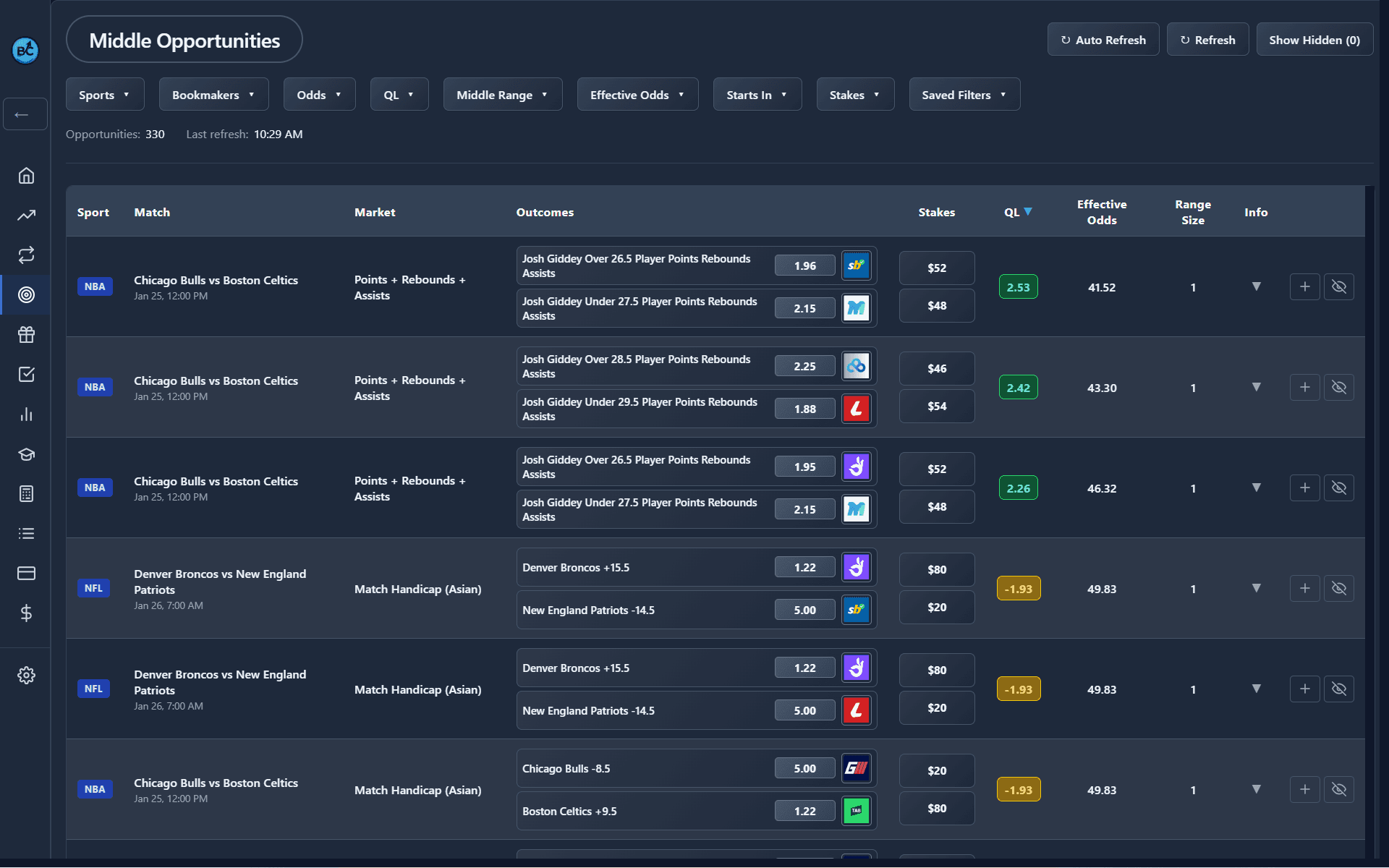
Profitable middle opportunities don't last long. Good software displays all the information you need to place both bets quickly before the odds change.
Best practice is to have both bets ready to place with the correct stakes before confirming either bet, in case odds change on one bookmaker.
Setting Your Filters:
Configure your filters to show only the opportunities you want:
Sport - Best practice is to leave all selected.
Bookmakers - Choose bookmakers where you have accounts.
Odds - Set your preferred odds range.
QL% - Set maximum qualifying loss percentage. Lower QL% means less risk when the middle doesn't hit.
Effective Odds - Set minimum effective odds. Higher effective odds mean bigger profit when the middle hits.
Middle Range - Set minimum range size. Wider ranges have higher probability of hitting but may offer lower effective odds.
Starts In - Set time until event start. Best practice is betting close to start time, ideally within a few hours.
Stakes - Set your total stake amount and rounding preference. We recommend rounding to $5 for account sustainability.
The software shows your qualifying loss percentage, effective odds, and profit scenarios so you can make quick decisions on whether to take each middle opportunity.